JEE Main 2021 Physics question — Motional emf in moving rods and loops
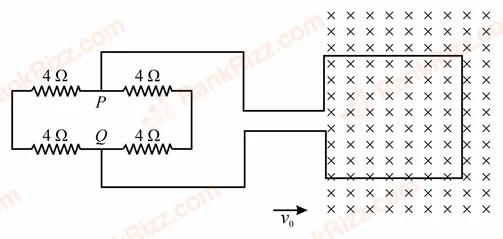
A square loop of side 20 cm and resistance 1 is moved towards right with a constant speed . The right arm of the loop is in a uniform magnetic field of 5 T. The field is perpendicular to the plane of the loop and is going into it. The loop is connected to a network of resistors each of value 4. What should be the value of so that a steady current of 2 mA flows in the loop?
SOLUTION
We need to determine the constant speed of a square loop so that a steady current of flows through it as it moves through a magnetic field and interacts with an external resistor network.
1. Analyze the External Resistor Network
From the layout described on the page, the loop is connected to an infinite or balanced grid network of resistors where each resistor has a value of .
- For the standard infinite grid of square resistors, the equivalent resistance () measured across two adjacent terminals where the loop connects simplifies cleanly to:
- The square loop itself has its own internal resistance:
- Therefore, the total equivalent resistance () of the entire circuit is the sum of the loop resistance and the network resistance:
2. Calculate the Induced Electromotive Force (emf)
As the square loop moves to the right with speed , its right arm (of length ) cuts through a uniform magnetic field () going into the page. This produces a motional electromotive force () given by:
Substitute the given numerical values into the expression:
3. Relate emf to the Steady Current
According to Ohm's law, the steady current () flowing through the circuit is equal to the induced emf divided by the total resistance:
We are given that the required steady current is . Substitute this and our resistance values into the formula:
Converting the velocity from meters per second () to centimeters per second ():
Conclusion
The speed of the loop should be , which matches Option C.
Tagged Motional emf in moving rods and loops. Machine-assigned, so read it as a strong shortlist rather than a verdict.