JEE Main 2020 Physics question — Meter bridge
In a meter bridge experiment is a standard resistance. is a resistance wire. It is found that balancing length is cm. If is replaced by a wire of half length and half diameter that of of same material, then the balancing distance (in cm) will now be ___________.
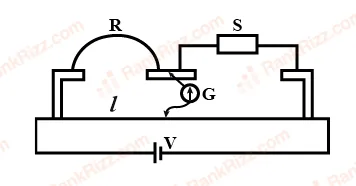
SOLUTION
In a meter bridge, the condition for a balanced Wheatstone bridge is given by the relation
where is the resistance in the resistance box arm, is the standard resistance, is the balancing length measured from one end, and the total length of the bridge wire is taken as 100 cm.
We are first told that the balancing length is . Substituting this value into the above relation, we obtain
Hence we conclude that
Now the wire of resistance is replaced by another wire made of the same material but having half the length and half the diameter. To find the new resistance of this wire, we recall the resistance formula
where is the resistivity of the material (unchanged because the material is the same), is the length, and is the cross-sectional area. For a cylindrical wire, the area is
with being the diameter.
Let the original wire have length and diameter , so its area is and its resistance is
The new wire has
• length
• diameter
The new area is therefore
Using the resistance formula again, the new resistance is
Thus we have the simple relation
Because the standard resistance remains unchanged, the new balance condition for the meter bridge becomes
where is the new balancing length to be found. Substituting and the earlier ratio , we get
Hence we must satisfy
Cross-multiplying, we write
Expanding the right-hand side gives
Next we collect the terms on one side:
which simplifies to
Finally, dividing by 5 yields
So, the answer is .
Tagged Meter bridge. Machine-assigned, so read it as a strong shortlist rather than a verdict.