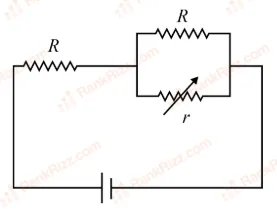
Rtotal=R+R+rRr=R+rR2+Rr+Rr=R+rR2+2Rr
I=RtotalV=R2+2RrV(R+r)
Ir=I×(R+rR)
Ir=(R2+2RrV(R+r))×R+rR=R2+2RrVR
P=Ir2⋅r: P=(R2+2RrVR)2⋅r
P=(R2+2Rr)2V2R2r
P=rR4+4R2r+4R3V2R2
For P to be maximum, the denominator D=(rR4+4R2r+4R3) must be minimum.
Using the AM-GM inequality, a sum of the form xa+bx is minimum when the two terms are equal:
rR4=4R2r
R2=4r2
R=2r⟹r=2R
f=21