JEE Main 2024 Physics question — Galvanometer conversion to ammeter and voltmeter
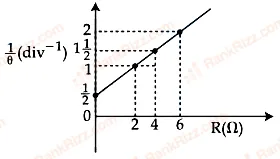
In the experiment to determine the galvanometer resistance by half-deflection method, the plot of vs the resistance of the resistance box is shown in the figure. The figure of merit of the galvanometer is ______ . [The source has emf 2V]
SOLUTION
In half-deflection method,
Current through galvanometer:
Deflection θ ∝ I
So:
This is of the form:
So slope
From graph:
Take two points:
Slope:
So:
Look at the markings:
the vertical values like are not raw values — they are compressed scale values
Because of this, the slope you calculate is actually 4 times smaller than the true slope
So real slope
Now:
Now convert to required form:
k=0.5A/div=5\times10⁻^1A/div
So answer = 5
Tagged Galvanometer conversion to ammeter and voltmeter. Machine-assigned, so read it as a strong shortlist rather than a verdict.