JEE Main 2020 Physics question — Wheatstone bridge
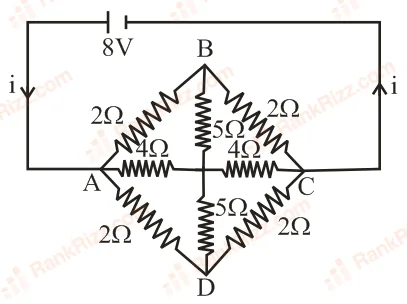
The value of current flowing from A to C in the circuit diagram is:
SOLUTION
First, let us read the information that is visible in the circuit. Between the terminals A and C there are two resistors, one of (marked between A and some intermediate point B) and the other of (marked between the same intermediate point B and C). Downstream, after C, a third resistor of joins the return line back to the negative terminal of a single ideal source of whose positive terminal is connected to A. In words, the three resistors of and are all in one line, so they are in series.
Whenever several resistors are in series, we add their resistances to get one equivalent resistance. Stating the formula for resistors in series,
Here we have only three resistors, so
Because the entire string of resistors is connected directly across the battery, this whole equivalent resistance of experiences the full of the source.
Now we invoke Ohm’s Law, which in its basic form is stated as
Substituting the values we have just extracted,
This current of is the same through every series element, because in a series circuit the current has only one possible path. In particular, the branch from A to C carries exactly this current. The symbol defined in the question as the current flowing from A to C is therefore equal to
Hence, the correct answer is Option D.
Tagged Wheatstone bridge. Machine-assigned, so read it as a strong shortlist rather than a verdict.