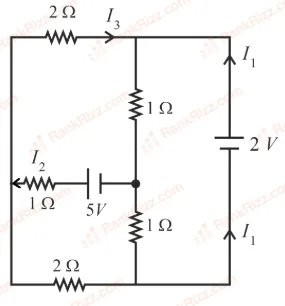
Let's use Nodal Analysis to find the currents in the circuit.
1. Set Reference Node:
Let the bottom wire (connected to the negative terminal of the 2 V battery and the bottom of the lower 1 Ω resistor) be at potential 0 V.
2. Determine Fixed Node Potentials:
The top wire connected to the positive terminal of the 2 V battery is at potential:
Vtop=2 V$
Let the central junction between the two 1 Ω resistors be node C at potential VC.
The middle branch has a 5 V battery with its positive terminal connected to node C. Therefore, the left node L between the 5 V battery and the middle 1 Ω resistor has potential VL=VC−5 V.
3. Apply Nodal Analysis at Node C:
The current entering node C from the top branch is 1Vtop−VC=12−VC.
The current leaving node C through the bottom 1 Ω resistor is 1VC−0=VC.
The current leaving node C through the middle branch (towards the left wire) is I2.
The left vertical wire connects the top 2 Ω resistor, middle 1 Ω resistor, and bottom 2 Ω resistor. Let the potential of this left vertical wire be V0.
Using KCL at the left vertical wire node:
2Vtop−V0+1VL−V0+20−V0=0$
22−V0+(VC−5−V0)−2V0=0$
1−2V0+VC−5−V0−2V0=0$
VC−4−2V0=0⟹V0=2VC−4$
4. Apply KCL at Node C:
12−VC=1VC−0+1VC−(V0+5)$
2−VC=VC+VC−5−V0$
2−VC=2VC−5−(2VC−4)$
Multiply the entire equation by 2:
4−2VC=4VC−10−VC+4$
4−2VC=3VC−6$
5VC=10⟹VC=2 V$
5. Calculate Current I1:
The current I1 flows upward through the 2 V battery. By KCL at the top node (Vtop=2 V):
The current flowing into the top 2 Ω resistor is:
I3=2Vtop−V0$
Since VC=2 V, we have V0=22−4=−1 V.
I3=22−(−1)=23=1.5 A$
The current flowing downward through the upper 1 Ω resistor is:
Idown=1Vtop−VC=12−2=0 A$
Therefore, by KCL at the top node:
I1=I3+Idown=1.5 A+0 A=1.5 A$
The magnitude of current I1 is 1.5 A (or 23 A).