RankRizz
JEE MAIN 2026 · 28 JAN S2+4 / −1MEDIUMTRANSCRIBED

JEE Main 2026 Physics question — Wheatstone bridge

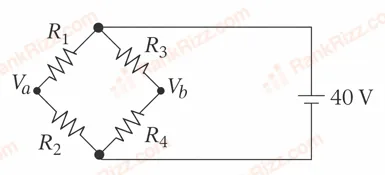
A Wheatstone bridge is initially at room temperature and all arms of the bridge have same value of resistances (R1=R2=R3=R4)(R_{1}=R_{2}=R_{3}=R_{4}). When R3R_{3} resistance is heated to some temperature, its resistance value has gone up by 10%. The potential difference (Va−Vb)(V_{a}-V_{b}) (after R3R_{3} is heated) is ____ V.

Figure for JEE Main 2026 Physics question on Wheatstone bridge
SOLUTION

Let the initial resistance of all arms be RR.

R1=R2=R4=R3=RR_1 = R_2 = R_4 = R_3=R

After heating, the resistance of R3R_3 increases by 10%.

R3=R+0.1R=1.1RR_3 = R + 0.1R = 1.1R

The potential at node aa (VaV_a) is determined by the voltage divider of R1R_1 and R2R_2 across the 40 V source.

Va=40×R2R1+R2V_a = 40 \times \frac{R_2}{R_1 + R_2}

Va=40×RR+RV_a = 40 \times \frac{R}{R + R}

Va=20 VV_a = 20 \text{ V}

The potential at node bb (VbV_b) is determined by the voltage divider of R3R_3 and R4R_4 across the same 40 V source.

Vb=40×R4R3+R4V_b = 40 \times \frac{R_4}{R_3 + R_4}

Vb=40×R1.1R+RV_b = 40 \times \frac{R}{1.1R + R}

Vb=40×12.1V_b = 40 \times \frac{1}{2.1}

Vb=40021 VV_b = \frac{400}{21} \text{ V}

The potential difference (Va−Vb)(V_a - V_b) is calculated as:

Va−Vb=20−40021V_a - V_b = 20 - \frac{400}{21}

Va−Vb=420−40021V_a - V_b = \frac{420 - 400}{21}

Va−Vb=2021 VV_a - V_b = \frac{20}{21} \text{ V}

=0.95V

Tagged Wheatstone bridge. Machine-assigned, so read it as a strong shortlist rather than a verdict.

SubjectPhysics
TopicWheatstone bridge
TypeMultiple choice