JEE Main 2022 Physics question — Meter bridge
In the given figure of meter bridge experiment, the balancing length AC corresponding to null deflection of the galvanometer is 40 cm. The balancing length, if the radius of the wire AB is doubled, will be _____ cm.
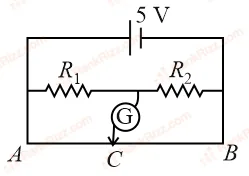
SOLUTION
We need to determine the new balancing length in a meter bridge experiment when the radius of the wire is doubled.
1. Understand the Working Principle of a Meter Bridge
A meter bridge operates on the principle of a balanced Wheatstone bridge. When the galvanometer shows null deflection (zero current), the ratio of the resistances in the two parallel arms is equal:
Where:
- and are the known and unknown resistances in the gaps.
- is the resistance of the balancing wire segment of length .
- is the resistance of the remaining wire segment of length .
2. Analyze the Resistance of the Wire Segments
The resistance of a uniform wire of length , resistivity , and cross-sectional area is given by:
For the two segments of the same uniform wire:
Substituting these into the balancing condition:
Notice that the resistivity () and the cross-sectional area () cancel out completely from the ratio. The balancing length depends only on the ratio of the resistances and , and the total length of the wire.
3. Effect of Doubling the Radius
When the radius of the wire is doubled, the cross-sectional area () increases uniformly across its entire length.
Since the area changes identically for both segments ( and ), it still cancels out in the balance equation. As long as the resistors and remain unchanged, the balancing length remains exactly the same.
Conclusion
Since the balancing length is independent of the thickness or radius of the uniform bridge wire, it will remain unchanged.
The balancing length will be 40 cm.
Tagged Meter bridge. Machine-assigned, so read it as a strong shortlist rather than a verdict.