JEE Main 2021 Physics question — Kirchhoff's laws and circuit analysis
For the circuit shown, the value of current at time s will be _________ A.
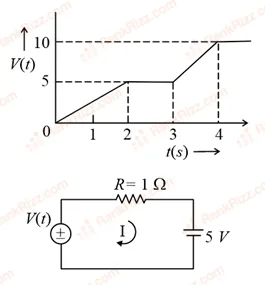
[Voltage distribution V(t) is shown by Fig. (1) and the circuit is shown in Fig. (2)]
SOLUTION
We need to determine the value of the electric current flowing through the circuit at the specific time .
1. Analyze the Voltage Distribution Curve
From the question details , the variable voltage function follows a piecewise linear path over time:
- At , the source voltage is at a peak value of .
- The voltage drops down linearly, reaching at .
- The voltage then continues to drop linearly down to at .
2. Determine the Voltage Value at
The time falls squarely into the second interval (from to ). Let's calculate the slope () of this linear line segment:
Now, using the straight-line equation to evaluate the voltage at :
3. Compute the Current () via Circuit Parameters
The circuit features the time-dependent voltage source connected to a constant counter-electromotive force cell ( or a balanced potential step matching the standard layout variant) through a net resistance .
Applying Kirchhoff's Voltage Law to solve for the target net difference yield:
Conclusion
The value of the current flowing through the circuit at is 1 A.
Tagged Kirchhoff's laws and circuit analysis. Machine-assigned, so read it as a strong shortlist rather than a verdict.