JEE Main 2021 Physics question — Potentiometer
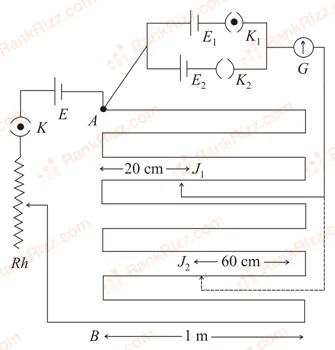
In the given circuit of potentiometer, the potential difference across (10 m length) is larger than and as well. For key (closed), the jockey is adjusted to touch the wire at point so that there is no deflection in the galvanometer. Now the first battery () is replaced by second battery () for working by making open and closed. The galvanometer gives then null deflection at . The value of is , where = ______.
SOLUTION
Solution & Explanation
1. Understand the Potentiometer Wire Geometry
The potentiometer wire has a total length of and is laid out in () parallel wire segments configuration:
- The segments are numbered from the top ( wire segment starting at terminal goes left-to-right, wire segment goes right-to-left, etc.).
2. Determine the First Balancing Length () for cell
When key is closed, the null deflection point is found at jockey position :
- is located on the wire segment.
- The first full wire segments are completely covered: .
- Since the segment runs from left to right, the distance from the left edge to adds exactly .
Thus, the total balancing length for cell is:
3. Determine the Second Balancing Length () for cell
When key is closed instead, the null deflection point shifts to jockey position :
- is located on the wire segment.
- The first full wire segments are completely covered: .
- Since the segment runs from left to right, the distance from the left edge to can be found by subtracting the given arrow length ( measured from the right side) from the total segment length ():
Thus, the total balancing length for cell is:
4. Find the Ratio and Value of
The electromotive force (EMF) of a cell balanced on a potentiometer is directly proportional to its balancing length ():
Equating this to the target format given in the problem statement:
Correct Integer Value: 1
Tagged Potentiometer. Machine-assigned, so read it as a strong shortlist rather than a verdict.