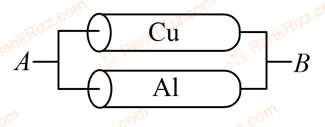
We need to find the total equivalent resistance of a parallel combination of a Copper (Cu) rod and an Aluminium (Al) rod between points A and B.
1. Extract Given Values and Convert to SI Units
- Length of each rod (L): 25 cm=0.25 m
- Cross-sectional area (Aarea): 3 mm2=3×10⁻⁶ m2
- Resistivity of Copper (ρCu): 1.7×10⁻⁸ Ω⋅m
- Resistivity of Aluminium (ρAl): 2.6×10⁻⁸ Ω⋅m
2. Calculate the Resistance of Each Individual Rod
The resistance of a conductor is given by the formula:
R=ρAareaL
For the Copper Rod (RCu):
RCu=(1.7×10−8)×3×10−60.25
RCu=30.425×10−2=34.25×10⁻³ Ω≈1.4167 mΩ
For the Aluminium Rod (RAl):
RAl=(2.6×10−8)×3×10−60.25
RAl=30.65×10−2=36.5×10⁻³ Ω≈2.1667 mΩ
3. Calculate the Equivalent Resistance (RAB) in Parallel
Since the two rods are connected side-by-side in a parallel configuration across terminals A and B, the equivalent resistance is calculated as:
RAB=RCu+RAlRCu×RAl
Let's factor out the common term 10−3 to simplify calculation with fractions:
RAB=(34.25+36.534.25×36.5)×10−3 Ω
RAB=(310.75927.625)×10−3 Ω
RAB=(927.625×10.753)×10−3 Ω
RAB=(3×10.7527.625)×10−3 Ω=32.2527.625×10−3 Ω
RAB≈0.8566×10⁻³ Ω≈0.858 mΩ
Final Answer: 0.858 mΩ