JEE MAIN 2025 · 07 APR S1+4 / −1MEDIUMTRANSCRIBED
JEE Main 2025 Physics question — Wheatstone bridge
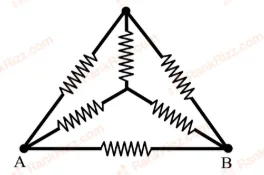
A wire of resistance R is bent into a triangular pyramid as shown in figure with each segment having same length. The resistance between points A and B is R/n. The value of n is :
SOLUTION
All edges have equal resistance. Total wire resistance = R.
Number of edges in a tetrahedron = 6
So resistance of each edge:
Now find equivalent between two vertices (say A and B).
By symmetry, the other two vertices are at same potential no current flows between them.
So that edge can be ignored.
Now circuit reduces to:
- Direct edge A-B: r
-
Two identical paths A (top nodes) B
Each path has 2 resistors in series 2r
So we have 3 parallel paths:
Substitute
Tagged Wheatstone bridge. Machine-assigned, so read it as a strong shortlist rather than a verdict.