JEE Main 2008 Physics question — Electric current, current density and drift velocity
Paragraph: Consider a block of conducting material of resistivity '' shown in the figure. Current '' enters at '' and leaves from ''. We apply superposition principle to find voltage '' developed between '' and ''. The calculation is done in the following steps: (i) Take current '' entering from '' and assume it to spread over a hemispherical surface in the block. (ii) Calculate field at distance '' from by using Ohm's law , where is the current per unit area at ''. (iii) From the '' dependence of , obtain the potential at . (iv) Repeat (i), (ii) and (iii) for current '' leaving '' and superpose results for '' and ''.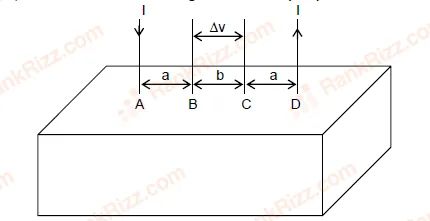
Question: For current entering at , the electric field at a distance '' from is
SOLUTION
When the current enters the block at point it spreads radially through the conducting material. Because the current can occupy only the half-space inside the block, the current lines fill a hemispherical surface of radius centred at .
Area of a complete sphere of radius is . Hence the area of the hemisphere that actually carries current is
Step (i) Current density is the current per unit area on this hemispherical surface:
Step (ii) Ohm’s law in microscopic form relates the electric field and the current density through the resistivity :
Substituting the expression for , we obtain
Thus the magnitude of the electric field at a distance from point is
Therefore the correct option is Option C which is: .
Tagged Electric current, current density and drift velocity. Machine-assigned, so read it as a strong shortlist rather than a verdict.