JEE Main 2008 Physics question — Ohm's law, resistance, resistivity and colour code
Paragraph: Consider a block of conducting material of resistivity '' shown in the figure. Current '' enters at '' and leaves from ''. We apply superposition principle to find voltage '' developed between '' and ''. The calculation is done in the following steps: (i) Take current '' entering from '' and assume it to spread over a hemispherical surface in the block. (ii) Calculate field at distance '' from by using Ohm's law , where is the current per unit area at ''. (iii) From the '' dependence of , obtain the potential at . (iv) Repeat (i), (ii) and (iii) for current '' leaving '' and superpose results for '' and ''.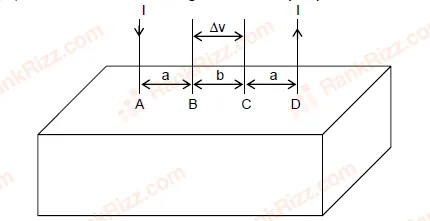
Question: measured between and is
SOLUTION
When a point current source injects a steady current into a large block of uniform resistivity , the current spreads radially inside the conductor. Close to the entry point the current lines form a hemisphere of radius (only the half-space inside the block is available). The surface area of this hemisphere is .
Case 1: Current entering at
Current density at distance from is obtained from the definition :
Ohm’s law for a conductor gives the magnitude of the electric field:
The field is radial, so the potential difference between two points at radii and from is the line integral of :
Choosing the reference potential at a very large distance (effectively , where the term vanishes) the absolute potential at a point a distance from is
In the block the points and lie on the line joining them to at distances
.
Hence
Case 2: Current leaving at
Exactly the same reasoning applies near , but now the current is directed out of the conductor. The electric field near therefore points towards , making its contribution to the scalar potential negative. In the given geometry points and are equidistant from (the figure shows them located symmetrically with respect to ). Consequently, the potentials produced by the exit current at and are equal and cancel in the difference :
Total potential difference
Superposing the two cases:
This matches Option C.
Answer: Option C which is:
Tagged Ohm's law, resistance, resistivity and colour code. Machine-assigned, so read it as a strong shortlist rather than a verdict.