JEE Main 2021 Physics question — Kirchhoff's laws and circuit analysis
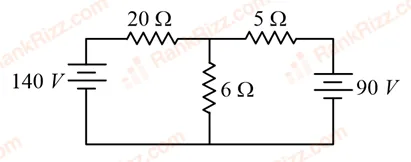
The value of current in the 6 resistance is:
SOLUTION
Solution & Explanation
1. Set up the Nodal Analysis
Let's find the current flowing through the central branch by using the Nodal Voltage Method, which is the most direct approach for this multi-loop configuration:
- Let the bottom continuous wire segment act as our reference node (Ground), so its potential is .
- Let the top-center essential junction node directly above the resistor have an unknown potential designated as .
2. Apply Kirchhoff's Current Law (KCL)
According to Kirchhoff's Current Law, the sum of all currents leaving the central junction node must equal zero ():
To eliminate the fractions, let's find the Least Common Multiple (LCM) of the denominators (, , and ), which is . Multiply the entire equation by :
Expand the individual terms:
Group the like variables together:
3. Calculate the Branch Current ()
Now that we know the node potential at the top of the central resistor is , we can use Ohm's Law to calculate the current passing down through the resistor:
Correct Option: C ()
Tagged Kirchhoff's laws and circuit analysis. Machine-assigned, so read it as a strong shortlist rather than a verdict.