JEE Main 2021 Physics question — Wheatstone bridge
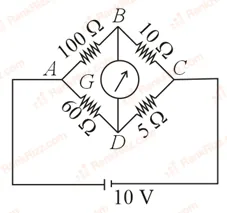
The four arms of a Wheatstone bridge have resistances as shown in the figure. A galvanometer of 15 resistance is connected across BD. Calculate the current through the galvanometer when a potential difference of 10 V is maintained across AC.
SOLUTION
The Wheatstone bridge has four resistances in its arms with a galvanometer of resistance connected across BD, and a potential difference of 10 V applied across AC. From the given figure, the arm resistances are , , , and .
We apply Thevenin's theorem across BD. With the galvanometer removed, B and D acquire potentials determined by the two voltage dividers. The potential at B (in the path A-B-C) is V. The potential at D (in the path A-D-C) is V.
The Thevenin voltage is V.
The Thevenin resistance, obtained by shorting the 10 V source, is the parallel combination of and in series with the parallel combination of and : .
The galvanometer current is A mA.
Tagged Wheatstone bridge. Machine-assigned, so read it as a strong shortlist rather than a verdict.