JEE Main 2021 Physics question — Cells: emf, internal resistance and combinations
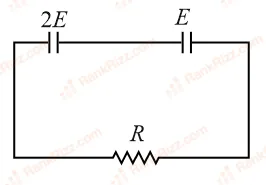
Two cells of emf and with internal resistance and respectively are connected in series to an external resistor (see figure). The value of , at which the potential difference across the terminals of the first cell becomes zero is:
SOLUTION
We need to determine the value of the external resistance at which the potential difference across the terminals of the first cell becomes zero.
1. Identify the Circuit Parameters
From the circuit diagram, two cells are connected in series aiding each other (their polarities are aligned in the same direction to drive current together through the external resistor ):
- First Cell: Electromotive force = , Internal resistance =
- Second Cell: Electromotive force = , Internal resistance =
2. Calculate the Total Current () in the Circuit
Using Ohm's law for the complete series loop, the total current flowing through the circuit is equal to the total net electromotive force divided by the total equivalent resistance:
3. Set Up the Condition for Zero Potential Difference
The terminal potential difference () across the first cell during discharge is given by the expression:
According to the problem statement, this terminal potential difference is equal to zero ():
4. Solve for the External Resistance ()
Substitute our expression for total current () from Step 2 into the condition equation:
Divide both sides of the equation by to eliminate it:
Cross-multiply to clear the denominator:
Isolate the term containing by shifting the internal resistance terms to the right-hand side:
Conclusion
The value of the external resistor at which the terminal voltage of the first cell drops to zero is , which corresponds to Option B.
Tagged Cells: emf, internal resistance and combinations. Machine-assigned, so read it as a strong shortlist rather than a verdict.