JEE Main 2019 Physics question — Wheatstone bridge
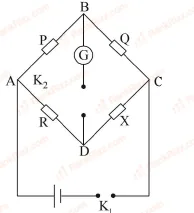
In a Wheatstone bridge (see fig.), Resistances P and Q are approximately equal. When , the bridge is balanced. On interchanging P and Q, the value of R, for balance, is . The value of Y is close to
SOLUTION
First recall the Wheatstone-bridge balance condition. When no current flows through the galvanometer, the ratio of the resistances in one pair of opposite arms equals the ratio in the other pair, i.e.
Here and are approximately equal resistances in the two upper arms, is the variable resistance in a lower arm, and is the fixed resistance in the remaining lower arm that we have to find.
We are given two different balance situations:
First balance - the arms are in that order and balance is obtained with . Using the balance condition, we write
Substituting gives
For convenience introduce the ratio
Equation (1) then becomes
Second balance - now and are interchanged, so the arms are . Balance is obtained with a new resistance value . Again applying the balance condition, but with the new order, we obtain
Since and , this becomes
Cross-multiplying equation (3) gives
Now we have two separate expressions for , namely equation (2) and equation (4). Because they represent the same resistance, we equate them:
Multiplying both sides by to clear the denominator, we get
Solving for ,
Taking the (positive) square root,
We next substitute this value of back into either equation (2) or equation (4) to find . Using equation (4):
To simplify, notice that
Therefore,
Calculating the product inside the square root,
and taking the square root:
Hence, the correct answer is Option D.
Tagged Wheatstone bridge. Machine-assigned, so read it as a strong shortlist rather than a verdict.