JEE Main 2023 Physics question — Kirchhoff's laws and circuit analysis
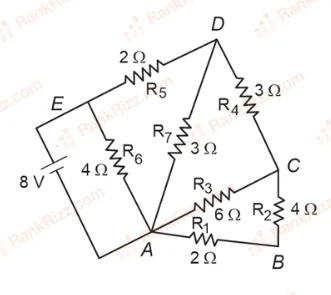
The current flowing through is:
SOLUTION
The left-hand branch contains a cell of emf and internal resistance .
The right-hand branch contains a cell of emf and internal resistance .
The two junctions of the branches are connected by the resistor , whose current we have to find.
Case 1: Open-circuit condition ( removed )
With no external connection between the junctions, no current flows through either internal resistance, so the potentials of the junctions are simply equal to the emfs of their respective cells: the left junction is at and the right junction at with respect to the common return conductor.
Hence, when is connected, a potential difference of
exists across it, driving current from the left junction (higher potential) to the right junction (lower potential).
Case 2: Closed circuit ( in place )
The three resistances and now form one continuous path for the current. Applying Ohm’s law to this single loop,
The net emf acting in the direction of current is , and the total resistance encountered is
.
Therefore,
.
The current of flows from the left cell to the right cell through , that is, from the 6 V side to the 4 V side.
Hence, the magnitude of the current through is , which matches Option C.
Tagged Kirchhoff's laws and circuit analysis. Machine-assigned, so read it as a strong shortlist rather than a verdict.