JEE Main 2022 Physics question — Kinematics of uniform circular motion
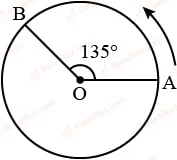
A person moved from to on a circular path as shown in figure. If the distance travelled by him is , then the magnitude of displacement would be: (Given )
SOLUTION
We need to find the magnitude of the displacement of a person who moves from point to point along a circular path, covering a distance of .
1. Relate Distance to the Radius () of the Circular Path
From the problem , let's assume the angle subtended by the arc at the center of the circular path is .
The arc length (distance traveled) is given by the formula:
Convert the angle from degrees to radians:
Substitute the given distance () to find the radius ():
2. Calculate the Magnitude of Displacement
The straight-line distance (displacement, ) between two points on a circle of radius separated by an angle can be calculated using the law of cosines or the standard shortcut formula:
Alternatively, using the given value of directly via the vector subtraction formula:
Substitute into the equation:
3. Substitute to Find the Final Value
Now, substitute and approximate along with :
Conclusion
The magnitude of the displacement is approximately 47 m, which corresponds to Option B.
Tagged Kinematics of uniform circular motion. Machine-assigned, so read it as a strong shortlist rather than a verdict.