JEE Main 2025 Physics question — Vehicles on curves: banking, friction and centrifugal force
A car of mass moves on a banked road having radius and banking angle To avoid slipping from the banked road, the maximum permissible speed of the car is The coefficient of friction between the wheels of the car and the banked road is:
SOLUTION
consider forces on the car on a banked road
forces acting:
- weight = mg (vertical downward)
- normal reaction = N (perpendicular to surface)
- friction = f (along surface)
for maximum speed, the car tends to slip up the incline, so friction acts down the slope
resolve forces:
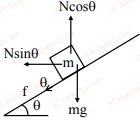
along horizontal (towards center provides centripetal force)
N sinθ + f cosθ = m v₀² / r
along vertical (no vertical acceleration)
N cosθ − f sinθ = mg
at limiting condition:
f = μN
substitute f = μN
horizontal:
N sinθ + μN cosθ = m v₀² / r
N (sinθ + μ cosθ) = m v₀² / r …(1)
vertical:
N cosθ − μN sinθ = mg
N (cosθ − μ sinθ) = mg …(2)
divide (1) by (2):
(sinθ + μ cosθ) / (cosθ − μ sinθ) = (v₀² / rg)
cross multiply:
sinθ + μ cosθ = (v₀² / rg)(cosθ − μ sinθ)
expand:
sinθ + μ cosθ = (v₀² / rg)cosθ − (v₀² / rg)μ sinθ
collect μ terms:
μ cosθ + (v₀² / rg)μ sinθ = (v₀² / rg)cosθ − sinθ
factor μ:
μ [cosθ + (v₀² / rg) sinθ] = (v₀² / rg)cosθ − sinθ
final expression:
μ = [ (v₀² / rg)cosθ − sinθ ] / [ cosθ + (v₀² / rg) sinθ ]
this is the required coefficient of friction for maximum speed.
Tagged Vehicles on curves: banking, friction and centrifugal force. Machine-assigned, so read it as a strong shortlist rather than a verdict.