JEE Main 2014 Physics question — Vertical circular motion
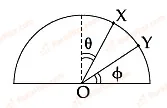
A particle is released on a vertical smooth semicircular track from point X so that, OX makes an angle from the vertical (see the figure). The normal reaction of the track on the particle vanishes at point Y, where OY makes an angle with the horizontal. Then:
SOLUTION
Let the potential energy be zero at the center . The initial height of the particle at point relative to is
At point , where makes an angle with the horizontal, the height relative to is
By the Law of Conservation of Energy between points and :
At point , the forces acting on the particle along the radial direction are the normal reaction and the radial component of weight . The centripetal force equation is:
The normal reaction vanishes at point (). Therefore,
Equating and :
Tagged Vertical circular motion. Machine-assigned, so read it as a strong shortlist rather than a verdict.