JEE Main 2019 Physics question — Dynamics of horizontal circular motion: conical pendulum, rotating drums
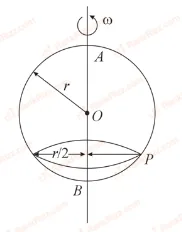
A smooth wire of length is bent into a circle and kept in a vertical plane. A bead can slide smoothly on the wire. When the circle is rotating with angular speed about the vertical diameter AB, as shown in figure, the bead is at rest with respect to the circular ring at position P as shown. Then the value of is equal to:
SOLUTION
Let the centre of the ring be and let the bead be at the position shown in the figure. The vertical diameter about which the ring is made to rotate is , so the axis of rotation passes through and is vertical. Draw the radius . In the figure supplied with the question the radius makes an angle of with the upward vertical direction (equivalently, it makes an angle of below the horizontal diameter through ). We denote this angle by , so
The bead is to remain at rest with respect to the ring, so we analyse forces in the non-inertial frame that co-rotates with the ring. In that rotating frame three forces act on the bead:
(i) its weight acting vertically downward,
(ii) the normal reaction of the wire, directed radially, i.e. along towards the centre,
(iii) the centrifugal (pseudo) force , where is the perpendicular distance of the bead from the axis of rotation (the line ) and is the horizontal unit vector directed away from the axis.
Because the ring is a circle of radius lying in its own plane, the coordinates of the point may be written as Hence the distance of from the axis (the vertical line , which is the -axis in this plane) is
Therefore the magnitude of the centrifugal force is and its direction is horizontally outward, i.e. along the positive -direction.
For the bead not to slide along the wire, the component of the total force along the tangent to the circle at must vanish. (A non-zero tangential component would give the bead a tangential acceleration relative to the ring.) The tangent to the circle at is perpendicular to the radius . A convenient non-unit vector along the tangent is
Resolving each force along this tangent:
• Component of weight along
• Component of centrifugal force along
• The normal reaction is radial; it is therefore perpendicular to the tangent, so
The condition for no motion of the bead relative to the ring is that the algebraic sum of the tangential components vanish:
Factorising ( at ), we get
Solving for gives the basic equilibrium condition
The minus sign disappears once we recognise that in the present situation is negative (because lies below the centre), so we may write
Now substitute the value of read from the figure:
Hence
This expression exactly matches Option C in the given list.
Hence, the correct answer is Option C.
Tagged Dynamics of horizontal circular motion: conical pendulum, rotating drums. Machine-assigned, so read it as a strong shortlist rather than a verdict.