JEE MAIN 2013 · 07 APR ONLINE+4 / −1EASYTRANSCRIBED
JEE Main 2013 Physics question — RC circuits: charging and discharging
In an LCR circuit shown below, both the switches are open initially. Now switch is closed, kept open. (q is charge on the capacitor and = RC is capacitive time constant). Which of the following statement is correct?
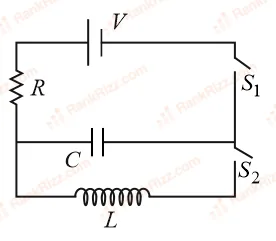
SOLUTION
The charge on the capacitor at any time is given by the charging equation , where is the capacitive time constant.
Option A: At :
Option B: At :
Option C: For a capacitor charging to its maximum, the work done by the battery is . The energy stored in the capacitor is , and the energy dissipated in the resistor is also . Therefore, the work done by the battery is twice the energy dissipated.
Option D: At :
Tagged RC circuits: charging and discharging. Machine-assigned, so read it as a strong shortlist rather than a verdict.