JEE MAIN 2020 · 06 SEP S1+4 / −1MEDIUMTRANSCRIBED
JEE Main 2020 Physics question — RC circuits: charging and discharging
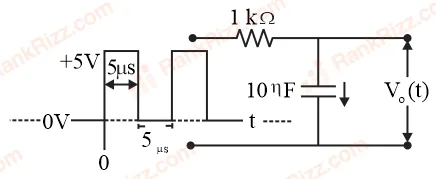
For the given input voltage waveform , the output voltage waveform , across the capacitor is correctly depicted by:
SOLUTION
The charging voltage across a capacitor in a series RC circuit is given by , where the time constant is .
Phase 1 ():
The input pulse of is applied with :
Phase 2 ():
The input source is open-circuited (high impedance), leaving no discharge path for the capacitor:
Phase 3 ():
The second pulse is applied with :
Answer: Option (A): rises to 2 V, holds its charge, and then rises further to 3 V.
Tagged RC circuits: charging and discharging. Machine-assigned, so read it as a strong shortlist rather than a verdict.