JEE Main 2021 Physics question — Capacitors in DC circuits (steady state)
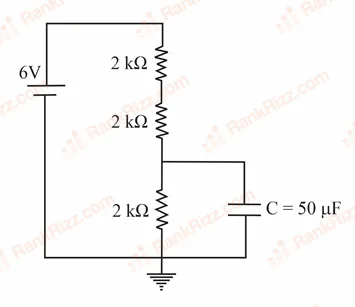
A capacitor of 50F is connected in a circuit as shown in figure. The charge on the upper plate of the capacitor is _________ C.
SOLUTION
We need to find the steady-state charge on the upper plate of the capacitor connected in the given circuit network.
1. Analyze the Circuit in Steady State
In a DC circuit, once the circuit reaches a steady state, a capacitor becomes fully charged and acts as an open circuit (infinite resistance). Therefore, no current flows through the branch containing the capacitor .
The entire current () supplied by the battery flows through the three series-connected resistors:
- (top resistor)
- (middle resistor)
- (bottom resistor, connected in parallel with the capacitor)
2. Calculate the Total Circuit Current ()
The total equivalent resistance () of the series circuit path is:
Using Ohm's law, the steady-state current running through the main loop is:
3. Determine the Potential Difference Across the Capacitor ()
The capacitor is connected in parallel across the bottom resistor (). Thus, the potential difference () across the plates of the capacitor equals the voltage drop across :
Looking at the polarity, the upper plate of the capacitor connects to a point higher up in the potential ladder relative to the ground terminal (), meaning the upper plate accumulates a positive charge.
4. Calculate the Charge on the Upper Plate ()
The magnitude of the charge accumulated on the capacitor is calculated using the formula:
Substitute the given value of capacitance () and the derived voltage drop:
Final Whole Number Answer:
Tagged Capacitors in DC circuits (steady state). Machine-assigned, so read it as a strong shortlist rather than a verdict.