JEE Main 2022 Physics question — Capacitors in DC circuits (steady state)
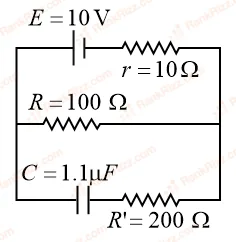
As shown in the figure, in steady state, the charge stored in the capacitor is _____ C.
SOLUTION
We need to find the charge stored in the capacitor under steady-state conditions for the given circuit.
1. Understand the Steady-State Condition
In a DC circuit, once a capacitor is fully charged and reaches a steady state, it acts as an open circuit (infinite resistance). This means:
- No current flows through the branch containing the capacitor () and the resistor ().
- Current only flows through the closed loop containing the battery (), its internal resistance (), and the parallel resistor ().
2. Calculate the Circuit Current ()
Using the values given in the circuit diagram
- EMF of the battery () =
- Internal resistance () =
- External resistance () =
The total current flowing through the main loop is:
3. Determine the Potential Difference Across the Capacitor ()
Since no current flows through the branch with , there is no potential drop across it (). Therefore, the potential difference () across the capacitor plates is exactly equal to the potential difference across the parallel resistor ():
4. Calculate the Stored Charge ()
The capacitance value given is . Using the formula for charge stored in a capacitor ():
We can rewrite as to simplify the expression easily:
Conclusion
The charge stored in the capacitor in steady state is 10 .
Tagged Capacitors in DC circuits (steady state). Machine-assigned, so read it as a strong shortlist rather than a verdict.