JEE Main 2021 Physics question — Capacitors with dielectrics
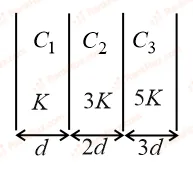
In the reported figure, a capacitor is formed by placing a compound dielectric between the plates of parallel plate capacitor. The expression for the capacity of the said capacitor will be: (Given the area of the plate = )
SOLUTION
We need to determine the expression for the equivalent capacitance of a parallel plate capacitor filled with three different dielectric slabs in a compound arrangement.
1. Identify individual Capacitances
From the diagram , the three dielectrics are placed back-to-back across the plate separation distance. This layout forms a series combination of three separate capacitors (, , and ):
-
First Section ():
Dielectric constant = , thickness = -
Second Section ():
Dielectric constant = , thickness = -
Third Section ():
Dielectric constant = , thickness =
2. Apply the Series Combination Formula
For capacitors connected in series, the equivalent capacitance () is given by:
Substitute the reciprocal values of , , and into the expression:
Factor out the common term :
3. Simplify the Fraction and Double-Check the Calculation
Find a common denominator for the terms inside the parentheses (which is ):
Now substitute this back into our equation for :
Inverting the expression gives the final total capacity:
Conclusion
The total capacity expression matches Option A perfectly:
Tagged Capacitors with dielectrics. Machine-assigned, so read it as a strong shortlist rather than a verdict.