JEE Main 2021 Physics question — Capacitors with dielectrics
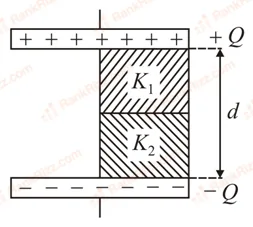
A parallel-plate capacitor with plate area has separation between the plates. Two dielectric slabs of dielectric constant and of same area and thickness are inserted in the space between the plates. The capacitance of the capacitor will be given by:
SOLUTION
We need to find the total capacitance of a parallel-plate capacitor when it is partially filled with two different dielectric slabs of dielectric constants and .
1. Analyze the Geometry of the Capacitor Slabs
Let's break the setup down into individual capacitor components by analyzing how the space is filled:
- Left Region (Unfilled): This region has an area of and a full separation distance of . It forms a single air capacitor ().
- Right Region (Filled): This region has a total area of . It contains two dielectric slabs ( and ), each having a thickness of , stacked on top of each other. These two slabs form a series combination of two distinct capacitors ( and ).
2. Calculate the Capacitance of Each Part
The standard formula for the capacitance of a parallel-plate capacitor with area , plate separation , and filled with a dielectric constant is given by:
Capacitors in the Right Stacked Region ( and ):
Both capacitors share a reduced plate area of and a halved thickness of .
- For the upper dielectric ():
- For the lower dielectric ():
Capacitor in the Left Air Region ():
This section contains air (), has an area of , and spans the full distance .
3. Combine the Individual Capacitances
Step A: Find the equivalent capacitance () of the stacked region
Since and are connected back-to-back in series across the vertical voltage drop, their equivalent capacitance is calculated as:
Step B: Find the total equivalent capacitance ()
The empty air branch () and the dielectric-filled branch () sit side-by-side, sharing the same top and bottom plates. Therefore, they are arranged in a parallel configuration:
Factoring out the common term gives the final expressions:
Final Answer: Option A
Tagged Capacitors with dielectrics. Machine-assigned, so read it as a strong shortlist rather than a verdict.