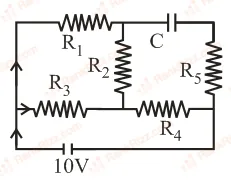
Steady-state circuit conditions:
Current through capacitor branch IC=0⟹IR5=0
Potential at the right plate of the capacitor Vright=0 V (connected to ground via R5)
Since IC=0, resistors R1 and R2 are in series. Let VB be the node voltage between R2,R3, and R4. The parallel combination of the upper branches connected to VB from the 10 V source is:
Rp=R3+(R1+R2)R3×(R1+R2)=2+42×(2+2)=68=34 Ω
Total circuit resistance connected to the source: Rtotal=Rp+R4=34+2=310 Ω
Voltage at node VB via potential divider rule: VB=10×RtotalR4=10×10/32=6 V
Potential at the left plate of the capacitor (VA), which lies between R1 and R2:
VA=VB+(R1+R2R2)(10−VB)=6+(2+22)(10−6)=8 V
Potential difference across the capacitor: VC=VA−Vright=8−0=8 V