JEE MAIN 2017 · 02 APR OFFLINE+4 / −1MEDIUMTRANSCRIBED
JEE Main 2017 Physics question — RC circuits: charging and discharging
In the given circuit diagram, when the current reaches a steady-state in the circuit, the charge on the capacitor of capacitance will be:
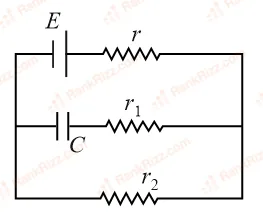
SOLUTION
In a DC circuit, once the capacitor reaches its steady-state (is fully charged), it acts as an open circuit. This means that no current flows through the branch containing the capacitor and the resistor . Consequently, the potential drop across is zero ().
Using Ohm's Law, the steady-state current
The potential difference across is
Since (steady state),
Tagged RC circuits: charging and discharging. Machine-assigned, so read it as a strong shortlist rather than a verdict.