JEE Main 2021 Physics question — Capacitors in DC circuits (steady state)
A 2F capacitor is first charged to a potential difference of 10 V using a battery. Then the battery is removed and the capacitor is connected to an uncharged capacitor of 8F. The charge in on equilibrium condition is ________ C. (Round off to the Nearest Integer)
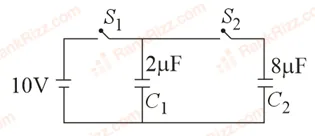
SOLUTION
We need to determine the electric charge stored in the second capacitor () after reaching an equilibrium condition when connected to a previously charged capacitor ().
1. Identify the Initial Charge on
Initially, only the first capacitor is connected to the voltage source while the second capacitor remains uncharged.
- Capacitance of the first capacitor () =
- Charging voltage () =
The initial charge () stored in is calculated using the formula :
2. Determine the Common Potential at Equilibrium ()
When the battery is disconnected and the charged capacitor is connected across the uncharged capacitor , charge redistributes between them until both plates reach an identical common potential ().
Since the capacitors are connected in a parallel-like configuration, the equivalent total capacitance () of the system is:
According to the law of conservation of charge, the total charge remains the same. The common equilibrium potential is given by:
3. Calculate the Charge on at Equilibrium
Now that we know the common operating voltage across the system is , we can find the final stable charge () remaining on the second capacitor:
Conclusion
The total accumulated charge on the capacitor under equilibrium conditions is 16 .
Tagged Capacitors in DC circuits (steady state). Machine-assigned, so read it as a strong shortlist rather than a verdict.