JEE Main 2018 Physics question — Capacitors in DC circuits (steady state)
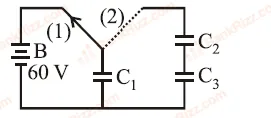
A capacitor C is charged up to a voltage V = 60 V by connecting it to battery B through switch (1). Now C is disconnected from battery and connected to a circuit consisting of two uncharged capacitors C = 3.0F and C = 6.0F through a switch (2) as shown in the figure. The sum of final charges on C and C is:
SOLUTION
With switch (1) closed and switch (2) open, the battery charges the capacitor to the voltage . The charge stored on just before the battery is removed is
After the battery is disconnected, the system is isolated; hence the algebraic sum of charges on all conductors will remain constant.
Closing switch (2) inserts the two initially uncharged capacitors and in series between the two plates of (see figure in the question).
This series chain provides a continuous conducting path between the plates of . Any residual potential difference across would drive a current through that path until the two plates of reached the same potential. Consequently, in the final steady state the potential difference across is zero and therefore
Because the system is isolated, the charge that initially resided on must now be present on the other two capacitors. Hence, from charge conservation,
The figure supplied with the question shows , so from
Substituting this value in gives
Therefore, the sum of the final charges on and is .
Answer (Option A): 36 C
Tagged Capacitors in DC circuits (steady state). Machine-assigned, so read it as a strong shortlist rather than a verdict.