JEE Main 2022 Physics question — Series LCR circuits: impedance and phase
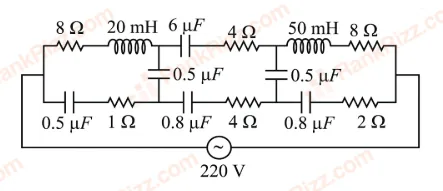
The effective current in the given circuit at very high frequencies will be ______ A.
SOLUTION
1. Component Behavior at Very High Frequencies ()
In alternating current (AC) circuits, the reactances of inductors and capacitors are highly frequency-dependent:
- Inductors ( and ): The inductive reactance formula is . As , . This means inductors act as open circuits (broken wires), completely blocking current from entering the outer top branches.
- Capacitors (, , and ): The capacitive reactance formula is . As , . This means capacitors offer zero reactance and act as short circuits (ideal connecting wires).
2. Tracing the Simplified Network Paths
By substituting these high-frequency conditions into the schematic, we can track the continuous path from the left terminal of the source to the right terminal:
- The current first passes through the initial series resistor on the left:
- Next, the current reaches a split junction (let's call it Node A). Because the vertical capacitors are now shorted into clean wires, they link the top and bottom paths directly across the same electric potentials:
- Path 1: Directs current horizontally through the lower-middle resistor.
- Path 2: Directs current vertically upward through the shorted capacitor wire, horizontally across the upper-middle resistor, and back down through the second shorted capacitor wire.
- Finally, after exiting Node B, the current must pass through the last series resistor connected to the right terminal:
3. Calculate the Total Equivalent Resistance ()
First, evaluate the parallel network containing the two middle resistors:
Now, combine the entire remaining pathway, since , , and sit sequentially in series with each other:
4. Calculate the Effective Current ()
Applying Ohm's Law with the source root-mean-square voltage () and our corrected load impedance configuration:
Correct Numerical Answer: 44 A
`
Tagged Series LCR circuits: impedance and phase. Machine-assigned, so read it as a strong shortlist rather than a verdict.