JEE Main 2021 Physics question — Series LCR circuits: impedance and phase
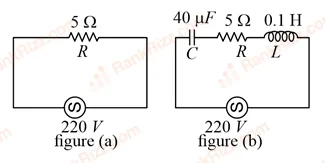
Two circuits are shown in figure (a) and (b). At a frequency of _________ rad s the average power dissipated in one cycle will be the same in both the circuits.
SOLUTION
We need to find the angular frequency () at which the average power dissipated per cycle is exactly the same for both alternating current (AC) circuits shown in the diagram.
1. Identify the Circuit Components
From the problem :
- Circuit (a): A pure resistive circuit containing only a resistor () connected across an AC voltage source of .
- Circuit (b): A series LCR circuit containing a capacitor (), a resistor (), and an inductor () connected across an identical AC voltage source of .
2. Analyze Average Power Dissipated
The average power dissipated () in an AC circuit depends on the root-mean-square voltage (), total impedance (), and the power factor ():
-
For Circuit (a):
Since it contains only a resistor, its impedance is simply . The power equation simplifies to: -
For Circuit (b):
The impedance of a series LCR circuit is given by , making its power:
3. Apply the Condition for Equal Power
Setting the average power values equal to each other ():
Cancel out and cross-multiply to solve:
This shows that for the power to be identical, circuit (b) must be operating at its resonance frequency, where the inductive reactance matches the capacitive reactance.
4. Calculate the Angular Frequency ()
Express the reactances in terms of angular frequency ():
Substitute the given values of and into the formula:
Conclusion
The average power dissipated in one cycle will be the same in both circuits at an angular frequency of 500 .
Tagged Series LCR circuits: impedance and phase. Machine-assigned, so read it as a strong shortlist rather than a verdict.