JEE Main 2026 Physics question — Series LCR circuits: impedance and phase
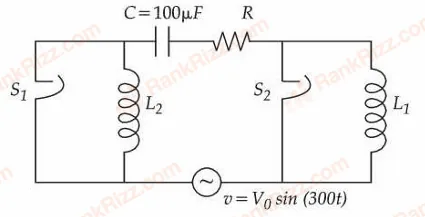
The figure given below shows an LCR series circuit with two switches S1 and S2. When switch S1 is closed keeping S2 open, the phase difference ϕ between the current and source voltage is 30° and phase difference is 60° when S2 is closed keeping S1 open. The value of (3L1−L2) is _________ H.
SOLUTION
The source voltage is v=V0sin300t, hence the angular frequency of the supply is ω=300rad s−1.
The capacitance is given as C=100μF=1×10⁻⁴F.
The capacitive reactance is therefore XC=ωC1=300×1×10−41=33.33Ω.
Let the resistance in the series circuit be R (it remains the same in both cases).
For an LCR series circuit the phase angle ϕ between source voltage and current is given by tanϕ=RXL−XC=RωL−XC−(1)
Case 1:
Switch S1 closed (inductance L1 active) and S2 open gives ϕ1=30∘.
Using (1): tan30∘=RωL1−XC 31=RωL1−XC R=3(ωL1−XC)−(2)
Case 2:
Switch S2 closed (inductance L2 active) and S1 open gives ϕ2=60∘.
Again using (1): tan60∘=RωL2−XC 3=RωL2−XC R=3ωL2−XC−(3)
Equate the two expressions for R from (2) and (3): 3(ωL1−XC)=3ωL2−XC
Multiplying by 3, 3(ωL1−XC)=ωL2−XC 3ωL1−ωL2=2XC ω(3L1−L2)=2XC−(4)
Substitute XC=ωC1 into (4): ω(3L1−L2)=ωC2 3L1−L2=ω2C2
Insert the numerical values ω=300rad s−1 and C=1×10⁻⁴F: ω2=(300)2=90000 ω2C=90000×1×10−4=9
Hence 3L1−L2=92H
Therefore, the required value is 92H.
Option B which is: 92
Tagged Series LCR circuits: impedance and phase. Machine-assigned, so read it as a strong shortlist rather than a verdict.