JEE Main 2024 Mathematics question — Sums of natural numbers, squares and cubes
Let the positive integers be written in the form:
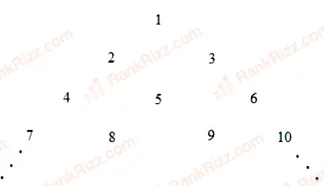
If the row contains exactly numbers for every natural number , then the row in which the number 5310 will be, is ________
SOLUTION
Notice the pattern of the last number in each row:
- Row 1 ends with:
- Row 2 ends with: (which is )
- Row 3 ends with: (which is )
- Row 4 ends with: (which is )
The last number in the row is simply the sum of the number of elements in the first rows. Using the standard summation formula for the first natural numbers, the last term of the row is:
We need to find the row that contains the number . This means must be strictly greater than the last number of the row and less than or equal to the last number of the row:
To find an approximate value for , let's simplify the inequality to rough squares:
We know that , so must be slightly larger than .
Let's test a couple of nearby values for the exact row endings:
- For : The last number of the 102nd row is .
- For : The last number of the 103rd row is .
Since , the number appears after the 102nd row has ended, placing it securely inside the 103rd row.
The row is .
Tagged Sums of natural numbers, squares and cubes. Machine-assigned, so read it as a strong shortlist rather than a verdict.