JEE Main 2015 Mathematics question — Equations with modulus and greatest integer
SOLUTION
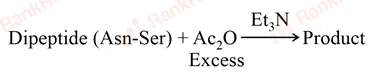
Asn (N-terminus): Contains a free primary amine () and a side-chain primary amide ().
Ser (C-terminus): Contains a side-chain hydroxyl group ().
Acetic anhydride () in excess acts as a powerful acetylating agent. In the presence of a base (), it replaces the active hydrogen atoms of nucleophilic functional groups with acetyl groups ( or ).
Under excess conditions, all accessible nucleophilic sites are acetylated:
N-terminal Amine: (Forms an acetamide).
Serine Side-chain: (Forms an ester).
Asparagine Side-chain: (Primary amides are acetylated to -acetyl amides when the reagent is in excess).
Option B is the correct product because it correctly shows the acetylation of all three reactive sites: the N-terminus, the serine hydroxyl, and the asparagine side-chain amide. The C-terminal carboxylic acid () remains in its acidic form.
Tagged Equations with modulus and greatest integer. Machine-assigned, so read it as a strong shortlist rather than a verdict.