JEE Main 2020 Mathematics question — Heights and distances
The angle of elevation of the summit of a mountain from a point on the ground is . After climbing up one km towards the summit at an inclination of from the ground, the angle of elevation of the summit is found to be . Then the height (in km) of the summit from the ground is:
SOLUTION
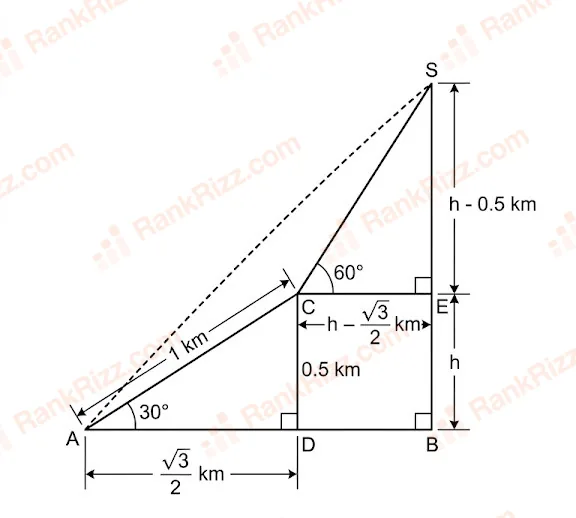
Let us denote the foot of the mountain by point , the first observation point on the ground by and the summit of the mountain by . We are asked to find the height (in km) of the mountain.
We first translate the given angles into the language of right-angle trigonometry. From point the angle of elevation of the summit is . Using the definition of the tangent function,
Because , we obtain the simple relation
We now move from a distance of exactly towards the summit along a path that is inclined at to the horizontal. Let the new point reached on this path be . Since the traveller is going “towards the summit”, the path lies in the plane containing and . From elementary resolution of a line segment inclined at we get:
vertical rise from to :
horizontal advance (towards the foot ):
Hence the height of point above the ground is
and the remaining vertical distance from to the summit is
Meanwhile the horizontal distance from point to the foot has decreased by , so it is now
But we already know , so
From point the angle of elevation of the summit is stated to be . Applying the tangent definition once more, this time in right-angled triangle , we have
Because , we write
To remove the denominator, we cross-multiply:
Expanding the left-hand side gives
and since , this becomes
Now we gather the terms on one side and the constants on the other side:
The right-hand constant simplifies because , so
Factoring out of the left-hand side, we obtain
Finally we solve for (the required height):
This expression exactly matches Option C given in the problem statement. Hence, the correct answer is Option C.
Tagged Heights and distances. Machine-assigned, so read it as a strong shortlist rather than a verdict.