JEE Main 2020 Mathematics question — Heights and distances
The angle of elevation of the top of a hill from a point on the horizontal plane passing through the foot of the hill is found to be . After walking a distance of meters towards the top, up a slope inclined at angle of to the horizontal plane the angle of elevation of the top of the hill becomes . Then the height of the hill (in meters) is_____.
SOLUTION
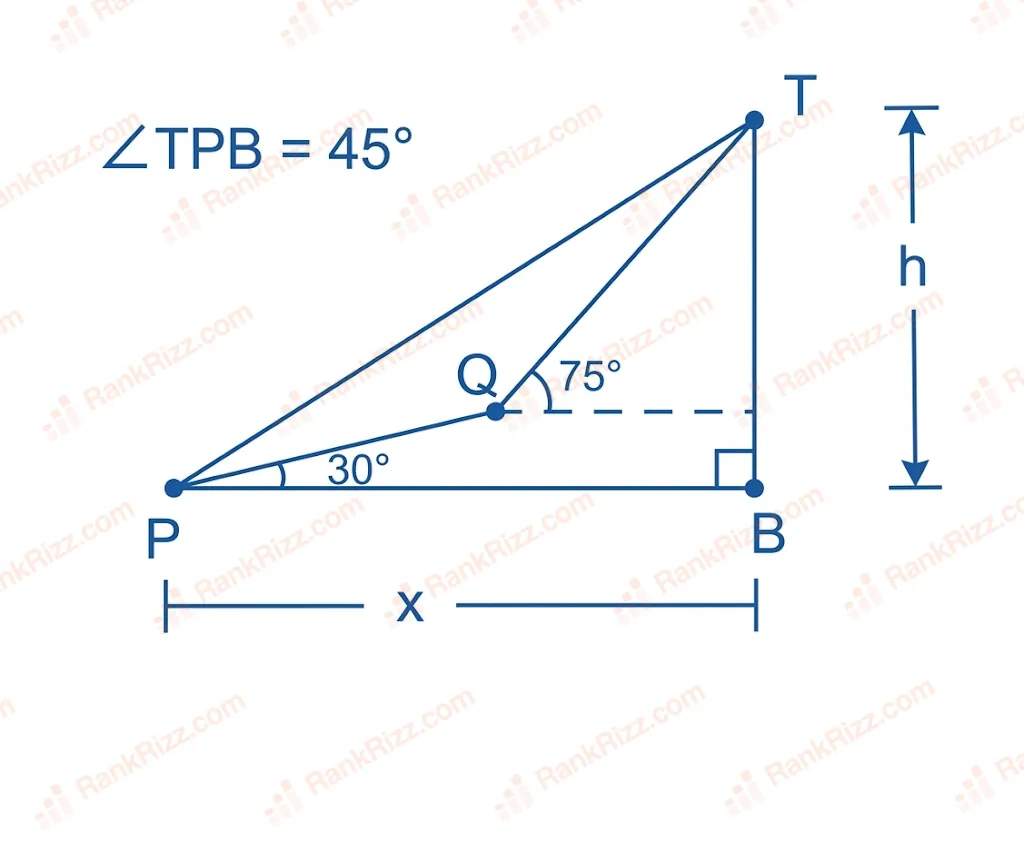
Let the foot of the hill be the point and let the top of the hill be the point . We take the horizontal plane through as our reference ground level.
We first stand at a point on this horizontal plane such that the angle of elevation of from is . If the horizontal distance is denoted by metres and the vertical height of the hill is denoted by metres, then by the definition of tangent we have
Since , this at once gives
Now we walk from directly towards the top, along a path that is inclined at to the horizontal, and we cover a distance of metres along this path. Let the new point of observation be . Because the path makes an angle of with the horizontal, we can resolve the m into horizontal and vertical components using the standard relations
Recalling that and , we obtain
Thus, compared with point , the point is m closer to the foot horizontally and m higher vertically. Consequently the horizontal distance from to equals
and the height of above the ground plane equals
From the angle of elevation of the top is now . The vertical separation between and is
while the horizontal separation is
Applying the definition of tangent again, we write
But we already have from the first observation, so we substitute to get
To solve for we first recall the exact value of . Using the angle-addition formula
and the facts and we find
Introduce the shorthand Our equation becomes
Cross-multiplying,
Expand the right side:
Rearrange to collect the terms on the left and constants on the right:
Factor out on the left:
Finally, divide by the coefficient (noting that ) to obtain explicitly:
We now substitute the exact value of . First compute and separately:
Taking the ratio,
Therefore
Thus the height of the hill is .
So, the answer is .
Tagged Heights and distances. Machine-assigned, so read it as a strong shortlist rather than a verdict.