JEE Main 2020 Mathematics question — Heights and distances
The angle of elevation of a cloud from a point , 200 m above a still lake is 30°. If the angle of depression of the image of in the lake from the point is 60°, then (in m) is equal to
SOLUTION
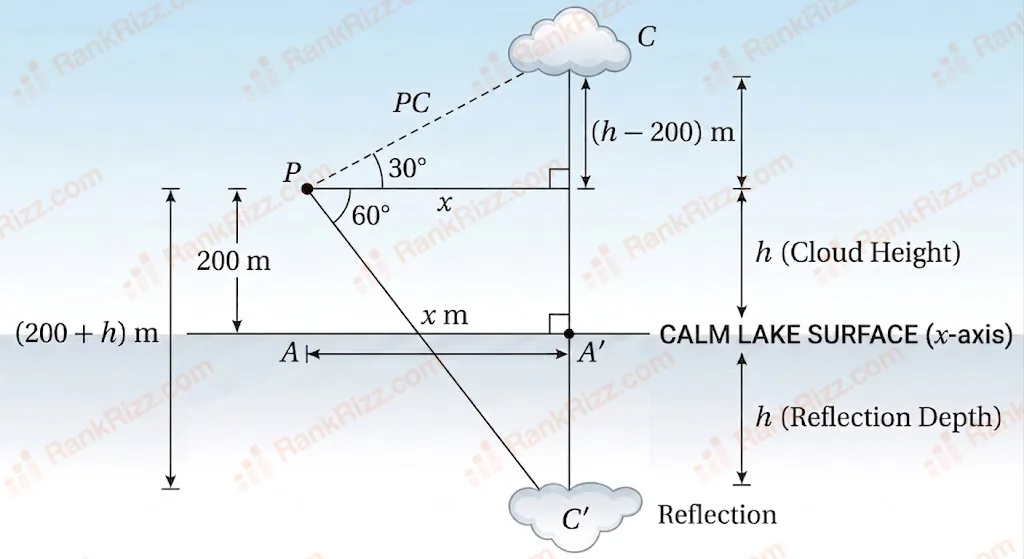
Let the still surface of the lake be a horizontal plane. Choose a point on this surface such that the given point lies vertically above . We are told that is 200 m above the lake, so .
Let the cloud be and its image in the lake be . Because an image in a perfectly still lake is formed by reflection in the water surface, and are on the same vertical line through , with exactly midway between them. If we denote the height of the cloud above the lake by metres, then
is metres below the water surface.
Put the horizontal distance of both and from the foot as metres. Thus the coordinates (taking the lake surface as the -axis and up as positive ) can be visualised as
The angle of elevation of from is 30°. By the definition of tangent in a right triangle,
Since , we get
Next, the angle of depression of the image from is 60°. The angle of depression equals the angle the line of sight makes below the horizontal. Using the same tangent definition, we have
Because , this yields
Both equations (1) and (2) represent the same value of , so we equate them:
Multiplying both sides by to clear the denominator,
Expanding and rearranging step by step,
So the cloud is above the lake.
The vertical separation between and is therefore
Substituting into equation (1) (or equation (2)) to find ,
Now we know both the horizontal and vertical components of the line segment . Using the Pythagoras theorem, which states we have
Hence, the correct answer is Option C.
Tagged Heights and distances. Machine-assigned, so read it as a strong shortlist rather than a verdict.