RankRizz
JEE MAIN 2021 · 31 AUG S1+4 / −1MEDIUMTRANSCRIBED

JEE Main 2021 Mathematics question — Heights and distances

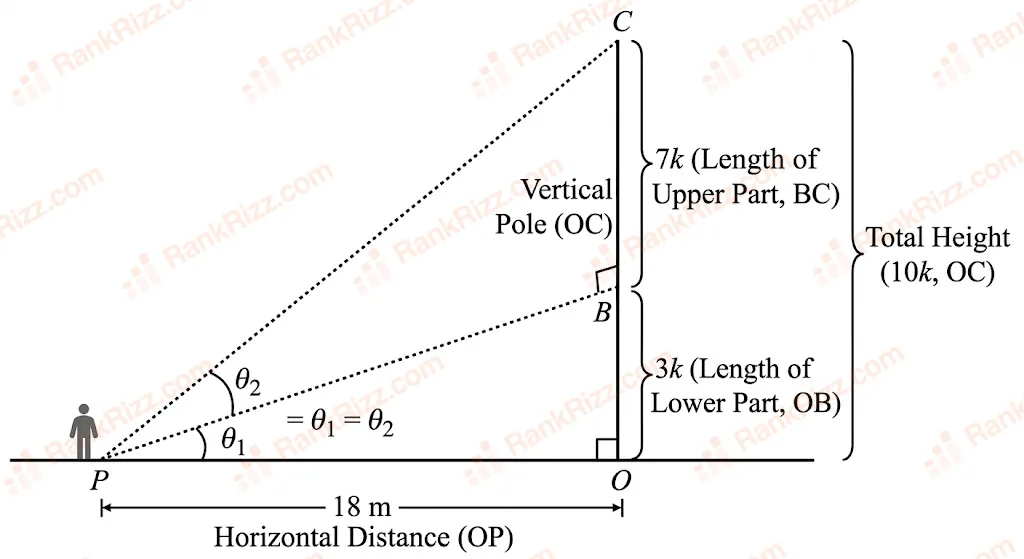
A vertical pole fixed to the horizontal ground is divided in the ratio 3 : 7 by a mark on it with lower part shorter than the upper part. If the two parts subtend equal angles at a point on the ground 18 m away from the base of the pole, then the height of the pole (in meters) is:

SOLUTION
image

Let us denote the foot of the pole on the ground by the point OO. The pole itself is vertical, so its topmost point is directly above OO.

The mark that divides the pole is such that the lower part and the upper part are in the ratio 3:73:7, with the lower part shorter. If we let the common proportionality constant be kk metres, then

length of lower part =3k,\text{length of lower part } = 3k, length of upper part =7k,\text{length of upper part } = 7k, total height of pole =3k+7k=10k.\text{total height of pole } = 3k + 7k = 10k.

Now choose a point PP on the horizontal ground such that the horizontal distance between PP and the foot OO of the pole is 18 m18\text{ m}. According to the question, the two parts of the pole individually subtend equal visual angles at the point PP.

It is convenient to introduce the heights of the relevant points above the ground:
O:height 0,O : \text{height } 0, B:height 3k,B : \text{height } 3k, C:height 10k.C : \text{height } 10k.

The two visual angles at PP are:

θ1=∠OPB=arctan⁡ ⁣(3k18)−arctan⁡ ⁣(018)\theta_1 = \angle OPB = \arctan\!\left(\frac{3k}{18}\right) - \arctan\!\left(\frac{0}{18}\right) θ1=arctan⁡ ⁣(3k18),\phantom{\theta_1}= \arctan\!\left(\frac{3k}{18}\right),

θ2=∠BPC=arctan⁡ ⁣(10k18)−arctan⁡ ⁣(3k18).\theta_2 = \angle BPC = \arctan\!\left(\frac{10k}{18}\right) - \arctan\!\left(\frac{3k}{18}\right).

The condition given is θ1=θ2\theta_1 = \theta_2, so

arctan⁡ ⁣(3k18)  =  arctan⁡ ⁣(10k18)−arctan⁡ ⁣(3k18).\arctan\!\left(\frac{3k}{18}\right) \;=\; \arctan\!\left(\frac{10k}{18}\right) - \arctan\!\left(\frac{3k}{18}\right).

Set α=arctan⁡ ⁣(3k18).\alpha = \arctan\!\left(\frac{3k}{18}\right). Then the equality becomes

α=arctan⁡ ⁣(10k18)−α,\alpha = \arctan\!\left(\frac{10k}{18}\right) - \alpha,

so that

2α=arctan⁡ ⁣(10k18).2\alpha = \arctan\!\left(\frac{10k}{18}\right).

Next we use the double-angle formula for tangent, namely tan⁡(2α)=2tan⁡α1−tan⁡2α.\tan(2\alpha) = \frac{2\tan\alpha}{1 - \tan^{2}\alpha}.

We have tan⁡α=3k18=k6,\tan\alpha = \frac{3k}{18} = \frac{k}{6}, hence

tan⁡(2α)=2(k6)1−(k6)2=2k61−k236=k31−k236.\tan(2\alpha) = \frac{2\left(\tfrac{k}{6}\right)}{1 - \left(\tfrac{k}{6}\right)^{2}} = \frac{\tfrac{2k}{6}}{1 - \tfrac{k^{2}}{36}} = \frac{\tfrac{k}{3}}{1 - \tfrac{k^{2}}{36}}.

But tan⁡(2α)\tan(2\alpha) is also, from above, tan⁡ ⁣(arctan⁡ ⁣(10k18))=10k18=5k9.\tan\!\Bigl(\arctan\!\bigl(\tfrac{10k}{18}\bigr)\Bigr) = \frac{10k}{18} = \frac{5k}{9}.

Equating the two expressions for tan⁡(2α)\tan(2\alpha) gives

k31−k236=5k9.\frac{\tfrac{k}{3}}{1 - \tfrac{k^{2}}{36}} = \frac{5k}{9}.

The factor k≠0k\neq 0 cancels out, leaving

13 ⁣ ⁣  / ⁣ ⁣(1−k236)=59.\frac{1}{3\!\!}\;\Big/\!\!\left(1 - \frac{k^{2}}{36}\right) = \frac{5}{9}.

Cross-multiplying,

13=59(1−k236).\frac{1}{3} = \frac{5}{9}\left(1 - \frac{k^{2}}{36}\right).

Multiply both sides by 99:

3=5(1−k236).3 = 5\left(1 - \frac{k^{2}}{36}\right).

Expand the right-hand side:

3=5−5k236.3 = 5 - \frac{5k^{2}}{36}.

Transpose 55 to the left:

3−5=−5k236,3 - 5 = -\frac{5k^{2}}{36}, −2=−5k236.-2 = -\frac{5k^{2}}{36}.

Multiply both sides by −1-1:

2=5k236.2 = \frac{5k^{2}}{36}.

Multiply by 3636:

72=5k2.72 = 5k^{2}.

Hence

k2=725,k=725=625=6105.k^{2} = \frac{72}{5}, \quad k = \sqrt{\frac{72}{5}} = \frac{6\sqrt{2}}{\sqrt{5}} = \frac{6\sqrt{10}}{5}.

The total height of the pole is

10k=10×6105=60105=1210 metres.10k = 10 \times \frac{6\sqrt{10}}{5} = \frac{60\sqrt{10}}{5} = 12\sqrt{10}\text{ metres}.

Hence, the correct answer is Option C.

Tagged Heights and distances. Machine-assigned, so read it as a strong shortlist rather than a verdict.

TopicHeights and distances
TypeMultiple choice