JEE Main 2019 Mathematics question — Heights and distances
If the angle of elevation of a cloud from a point P which is 25 m above a lake be and the angle of depression of reflection of the cloud in the lake from P be , then the height of the cloud (in meters) from the surface of the lake is:
SOLUTION
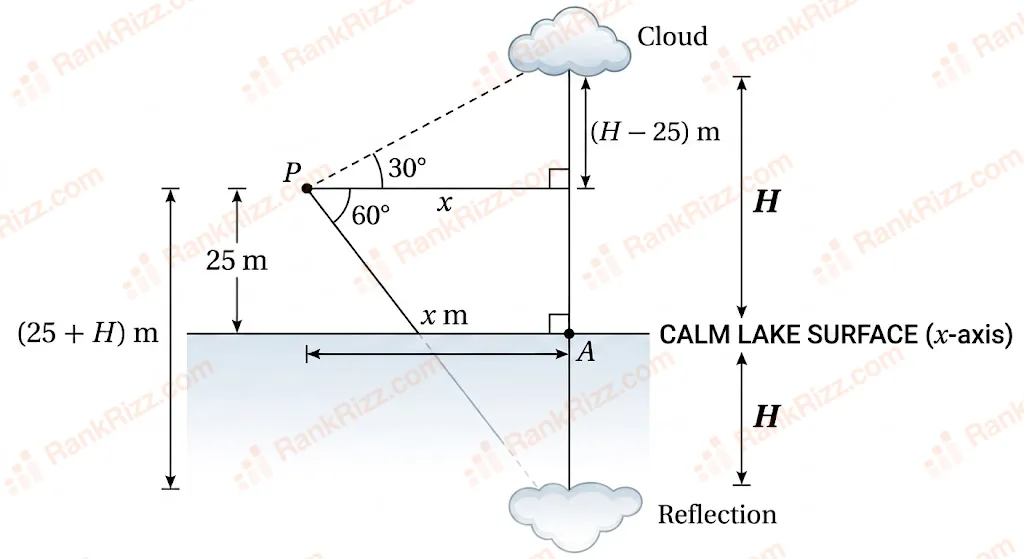
Let us imagine the calm surface of the lake as the horizontal reference line. The cloud is somewhere vertically above this surface, and its mirror image (the reflection) is the same vertical distance below the surface. The point is on a tower or pole that rises above the lake.
Call the unknown height of the cloud above the lake . Draw a vertical line through the cloud down to the lake and further down to its reflection; call the foot of that vertical line on the lake’s surface . Join to the actual cloud and also join to the reflection. Let the horizontal distance from to be .
We now have two right-angled triangles that share the same base :
1. Triangle -cloud, lying above the lake.
2. Triangle -reflection, lying below the lake.
The problem gives two angles:
• The angle of elevation of the cloud from is .
• The angle of depression of the reflection from is .
The basic trigonometric fact we will use is the definition of the tangent of an angle in a right-angled triangle:
First apply this to the cloud itself. In triangle -cloud, the side opposite the angle is the vertical segment from down to the lake’s surface (that length is , because is the cloud’s height above the lake and is the height of above the lake). The adjacent side is the horizontal segment of length . Hence
We know , so
which gives
Next apply the same idea to the reflection. In triangle -reflection, the angle at is a depression; its opposite side is the full vertical drop from down to the reflection. That drop equals (down to the lake and then a further to the reflection). The adjacent side is again the same horizontal length . Therefore
Because , we have
so that
Both expressions represent the same , so we equate them:
Multiply both sides by to clear the denominator:
Expand the left side:
Bring the terms together and the constants together:
Divide by :
Thus the cloud is above the surface of the lake.
Hence, the correct answer is Option A.
Tagged Heights and distances. Machine-assigned, so read it as a strong shortlist rather than a verdict.