JEE Main 2020 Mathematics question — Random variables, mean and variance
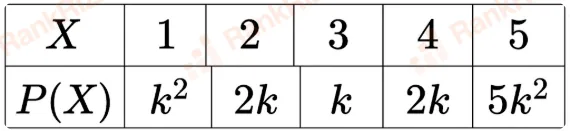
A random variable X has the following probability distribution:
Then, P(X>2) is equal to:
SOLUTION
For a discrete random variable the very first property we use is: “The sum of all the probabilities is equal to 1.” Stated mathematically, if the possible values of X are x1,x2,…,xn with respective probabilities p1,p2,…,pn, then
i=1∑npi=1.
Here the values and probabilities are given as
XP(X):12345,:k22kk2k5k2.
Applying the above property, we write
k2+2k+k+2k+5k2=1.
Now we collect like terms:
(k2+5k2)+(2k+k+2k)=1,
6k2+5k=1.
Next we transpose the 1 to the left side so that every term lies on the same side of the equality:
6k2+5k−1=0.
This is a quadratic equation in k of the standard form ax2+bx+c=0. We now invoke the quadratic-formula, which states
x=2a−b±b2−4ac,forax2+bx+c=0.
With a=6,b=5,c=−1 we substitute:
k=2⋅6−5±52−4⋅6⋅(−1).
Inside the square root we simplify step by step:
52=25,−4⋅6⋅(−1)=24,
so
25+24=49=7.
Hence
k=12−5±7.
This yields two numerical possibilities:
k=12−5+7=122=61,k=12−5−7=12−12=−1.
Because probability values must be non-negative, we discard the negative root. Therefore
k=61.
We now proceed to the requested probability P(X>2). The condition X>2 corresponds to the outcomes X=3,4,5. Using the definition of probability for mutually exclusive events, we add their individual probabilities:
P(X>2)=P(X=3)+P(X=4)+P(X=5).
Substituting the expressions given in the table, we get
P(X>2)=k+2k+5k2.
First we combine like terms:
k+2k=3k,
so
P(X>2)=3k+5k2.
Now we replace k by the value already obtained, k=61:
P(X>2)=3(61)+5(61)2.
We simplify each term separately. For the linear term,
3(61)=63=21.
For the quadratic term, first square the denominator: (61)2=361. Then multiply by 5:
5(361)=365.
Adding the two fractions with a common denominator of 36, we have
21+365=3618+365=3623.
Thus
P(X>2)=3623.
Consulting the options given, the fraction 3623 corresponds to Option D.
Hence, the correct answer is Option D.
Tagged Random variables, mean and variance. Machine-assigned, so read it as a strong shortlist rather than a verdict.