JEE Main 2025 Mathematics question — Permutations of letters and words, rank in dictionary
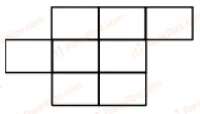
The number of ways, in which the letters A, B, C, D, E can be placed in the 8 boxes of the figure below so that no row remains empty and at most one letter can be placed in a box, is :
SOLUTION
To find the number of ways to place the letters A, B, C, D, and E into the 8 boxes such that no row remains empty, we first determine the number of ways to select 5 boxes from the grid under this constraint, and then arrange the 5 distinct letters within those selected boxes.
The grid consists of 8 boxes distributed across 3 horizontal rows with the configuration of 3 boxes in the top row, 2 boxes in the middle row, and 3 boxes in the bottom row:
Let and be the number of boxes selected from Row 1, Row 2, and Row 3 respectively. We need to choose a total of 5 boxes () such that no row is empty ().
---
Step 1: List the possible distributions of selecting the 5 boxes
Case 1: When 1 box is selected from the middle row ()
The remaining 4 boxes must be chosen from the top and bottom rows ():
Distribution (3, 1, 1):
Distribution (2, 1, 2):
Distribution (1, 1, 3):
Case 2: When 2 boxes are selected from the middle row ()
The remaining 3 boxes must be chosen from the top and bottom rows ():
Distribution (2, 2, 1):
Distribution (1, 2, 2):
---
Step 2: Calculate the total number of ways to select the 5 boxes
Summing the ways from all valid distributions:
---
Step 3: Arrange the 5 distinct letters in the selected boxes
The 5 distinct letters (A, B, C, D, E) can be arranged in the 5 chosen boxes in ways:
---
Step 4: Compute the final number of placements
Therefore, the total number of ways to place the letters is equal to 5760.
Tagged Permutations of letters and words, rank in dictionary. Machine-assigned, so read it as a strong shortlist rather than a verdict.