JEE Main 2023 Mathematics question — Intercepts and position of a point
A circle passing through the point in the first quadrant touches the two coordinate axes at the points A and B. The point P is above the line AB. The point Q on the line segment AB is the foot of perpendicular from P on AB. If PQ is equal to 11 units, then the value of is ______.
SOLUTION
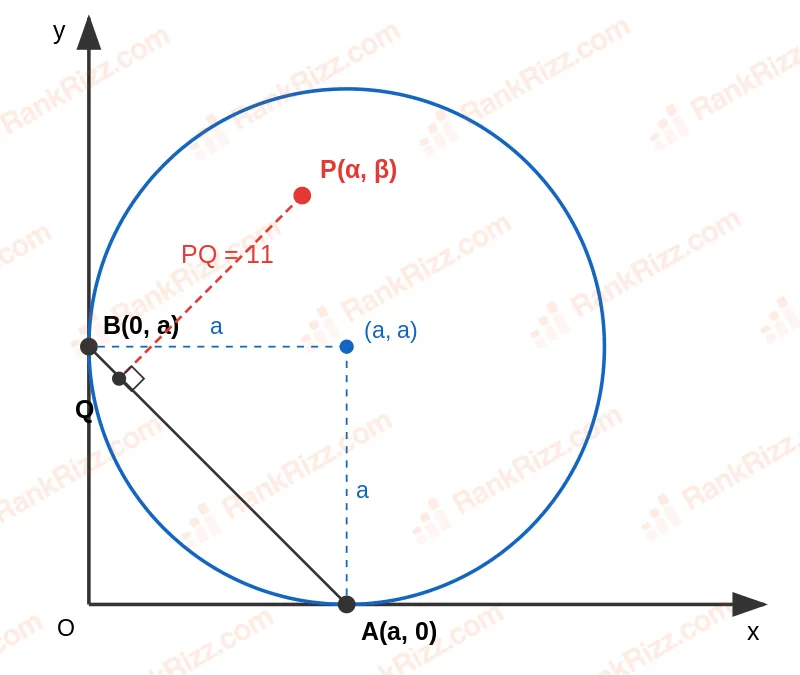
A circle in the first quadrant touches both coordinate axes. It passes through a point above the line AB, where A and B are the points where the circle touches the x-axis and y-axis respectively. PQ = 11 units, where Q is the foot of perpendicular from P onto line AB.
First, we set up the equation of the circle.
A circle touching both coordinate axes in the first quadrant has its centre at and radius . The equation of the circle is:
The circle touches the x-axis at and the y-axis at .
Next, we write the equation of line AB.
The line joining and has the equation:
From this, we use the perpendicular distance formula.
The perpendicular distance from to the line is:
Since P is above the line AB, we have , so:
Now, we use the condition that P lies on the circle.
Since lies on the circle:
Expanding:
Then, we rearrange and simplify.
Rewriting:
Continuing, we substitute from equation (i).
From equation (i), . Substituting:
The value of is 121.
Tagged Intercepts and position of a point. Machine-assigned, so read it as a strong shortlist rather than a verdict.