Given,
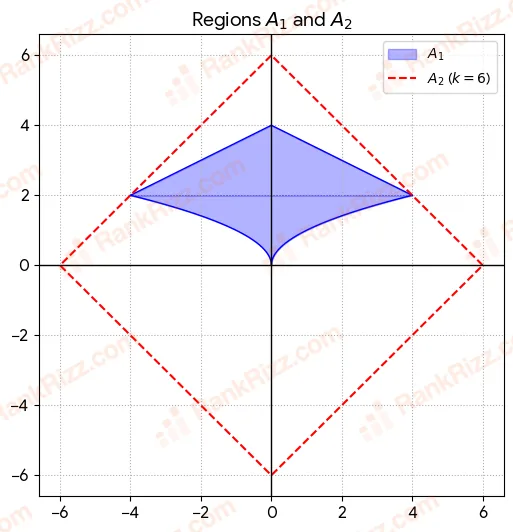
A1={(x,y):∣x∣≤y2, ∣x∣+2y≤8}
and
A2={(x,y):∣x∣+∣y∣≤k}
The region A1 is symmetric about the y-axis.
The curves
∣x∣=y2
and
∣x∣=8−2y
intersect at
y2=8−2y
y2+2y−8=0
y=2,−4
Taking the bounded upper region,
0≤y≤4
Now,
for
0≤y≤2,∣x∣≤y2
and for
2≤y≤4,∣x∣≤8−2y
Hence,
Area(A1)=2(∫02y2dy+∫24(8−2y)dy)
= 2(38+4)=340
Now,
∣x∣+∣y∣≤k
represents a square with diagonals along the coordinate axes.
Its area is
Area(A2)=2k2
Given,
27(Area A1)=5(Area A2)
27⋅340=5⋅2k2
360=10k2
k2=36
k=6
Hence,
6