RankRizz
JEE MAIN 2022 · 27 JUL S2+4 / −1HARDTRANSCRIBED

JEE Main 2022 Mathematics question — Area between curves

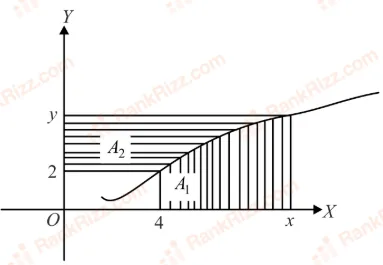
Consider a curve y=y(x)y = y(x) in the first quadrant as shown in the figure. Let the area A1A_1 is twice the area A2A_2. Then the normal to the curve perpendicular to the line 2x−12y=152x - 12y = 15 does NOT pass through the point

Figure for JEE Main 2022 Mathematics question on Area between curves
SOLUTION

We are given a curve y=y(x)y = y(x) in the first quadrant, with area A1A_1 being twice area A2A_2. We need to find which point the normal (perpendicular to 2x−12y=152x - 12y = 15) does NOT pass through.

From the figure description, for a point (x,y)(x, y) on the curve in the first quadrant:

A1A_1 = area under the curve from 0 to xx = ∫0xy dx\int_0^x y\,dx

A2A_2 = area to the left of the curve from 0 to yy = ∫0yx dy\int_0^y x\,dy

Since A1=2A2A_1 = 2A_2, and we know A1+A2=xyA_1 + A_2 = xy (the rectangle), we get 2A2+A2=xy2A_2 + A_2 = xy, so A2=xy3A_2 = \frac{xy}{3}.

Therefore A1=2xy3A_1 = \frac{2xy}{3}.

From A1=∫0xy dx=2xy3A_1 = \int_0^x y\,dx = \frac{2xy}{3}.

Differentiating both sides with respect to xx:

y=23(y+xy′)y = \frac{2}{3}(y + xy') 3y=2y+2xy′3y = 2y + 2xy' y=2xy′y = 2xy' dydx=y2x\frac{dy}{dx} = \frac{y}{2x} dyy=dx2x\frac{dy}{y} = \frac{dx}{2x} ln⁡y=12ln⁡x+C\ln y = \frac{1}{2}\ln x + C y=kxy = k\sqrt{x}

Since the curve passes through the first quadrant and using the standard form, y=kxy = k\sqrt{x}.

The line 2x−12y=152x - 12y = 15 has slope 212=16\frac{2}{12} = \frac{1}{6}.

The normal is perpendicular to this line, so the normal has slope −6-6.

Since y=kxy = k\sqrt{x}, y′=k2xy' = \frac{k}{2\sqrt{x}}.

The slope of the normal at any point is −1y′=−2xk-\frac{1}{y'} = -\frac{2\sqrt{x}}{k}.

Setting this equal to −6-6:

−2xk=−6  ⟹  x=3k  ⟹  x=9k2-\frac{2\sqrt{x}}{k} = -6 \implies \sqrt{x} = 3k \implies x = 9k^2

At this point, y=k9k2=k⋅3k=3k2y = k\sqrt{9k^2} = k \cdot 3k = 3k^2.

The normal passes through (9k2,3k2)(9k^2, 3k^2) with slope −6-6:

y−3k2=−6(x−9k2)y - 3k^2 = -6(x - 9k^2) y=−6x+54k2+3k2=−6x+57k2y = -6x + 54k^2 + 3k^2 = -6x + 57k^2

For the line y=−6x+57k2y = -6x + 57k^2:

Option A: (6,21)(6, 21): 21=−36+57k2⇒57k2=57⇒k2=121 = -36 + 57k^2 \Rightarrow 57k^2 = 57 \Rightarrow k^2 = 1. Valid.

Option B: (8,9)(8, 9): 9=−48+57k2⇒57k2=57⇒k2=19 = -48 + 57k^2 \Rightarrow 57k^2 = 57 \Rightarrow k^2 = 1. Valid.

Option C: (10,−4)(10, -4): −4=−60+57k2⇒57k2=56⇒k2=5657-4 = -60 + 57k^2 \Rightarrow 57k^2 = 56 \Rightarrow k^2 = \frac{56}{57}. NOT a clean value.

Option D: (12,−15)(12, -15): −15=−72+57k2⇒57k2=57⇒k2=1-15 = -72 + 57k^2 \Rightarrow 57k^2 = 57 \Rightarrow k^2 = 1. Valid.

Options A, B, and D all give k2=1k^2 = 1, meaning the normal passes through them. Option C does NOT lie on any such normal.

The correct answer is Option C: (10,−4)(10, -4).

Tagged Area between curves. Machine-assigned, so read it as a strong shortlist rather than a verdict.

TopicArea between curves
TypeMultiple choice