JEE Main 2019 Chemistry question — Catalysis: homogeneous, heterogeneous and enzyme
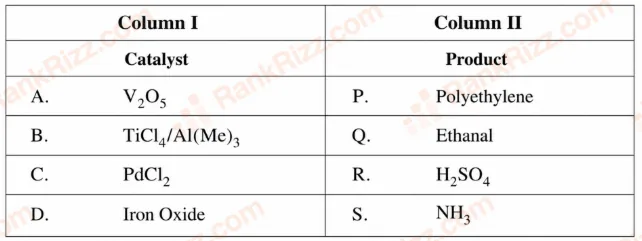
Match the catalysts (Column I) with products (Column II)
SOLUTION
We start by recalling the industrial reactions in which each given catalyst is characteristically employed.
For A we have , vanadium(V) oxide. This substance is the classical catalyst in the Contact Process where sulphur dioxide is oxidised to sulphur trioxide: The is then absorbed in water to give sulphuric acid . Hence the final product associated with is , which is entry R.
For B we have the pair . This pair is known as the Ziegler-Natta catalyst. The well-known use of this catalyst is the polymerisation of ethene () to polyethene: Polyethene is called polyethylene, which is entry P.
For C we are given , palladium(II) chloride. This salt is used in the Wacker oxidation, in which ethene is converted into acetaldehyde (ethanal): The product is ethanal, entry Q.
For D we have iron oxide, usually promoted with and , the heterogeneous catalyst in the Haber process: The resulting product is ammonia , entry S.
Collecting the matches we have
A - R, B - P, C - Q, D - S.
Comparing with the given options, this exact sequence corresponds to Option D.
Hence, the correct answer is Option D.
Tagged Catalysis: homogeneous, heterogeneous and enzyme. Machine-assigned, so read it as a strong shortlist rather than a verdict.