JEE Main 2021 Chemistry question — Stoichiometry, limiting reagent and percentage yield
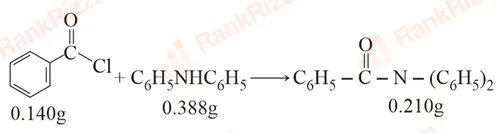
Consider the above reaction. The percentage yield of amide product is ________ (Round off to the Nearest Integer).
(Given: Atomic mass: C: 12.0u, H: 1.0u, N: 14.0u, O: 16.0u, Cl: 35.5u)
SOLUTION
To determine the percentage yield of the amide product, we first calculate the molar masses of the compounds involved using the given atomic masses, which are
for benzoyl chloride (), for diphenylamine (), and
for the resulting amide product (). Next, we find the number of moles for both reactants to identify the limiting reagent. The moles of benzoyl chloride are calculated as
, while the moles of diphenylamine are . Since , benzoyl chloride is the limiting reagent and dictates the maximum amount of product that can be formed. Using the 1:1 stoichiometric ratio, the theoretical yield of the amide product is .
Finally, we calculate the percentage yield by dividing the actual given yield () by the theoretical yield () and multiplying by 100, which gives. Rounding off to the nearest integer, the final percentage yield is 77.
Tagged Stoichiometry, limiting reagent and percentage yield. Machine-assigned, so read it as a strong shortlist rather than a verdict.